Call our Professional Contractors!
(949) 859-9969
Key Takeaways:
Orange County is a premium paver market. High labor rates, strict quality standards, and demanding site conditions push costs well above national averages. This guide gives you the real numbers by project type so you can plan accurately before you contact a single contractor.
Knowing the real cost range before you start is the single most important step in planning a paver project. Most homeowners who go over budget do so because they entered the process with national averages rather than local ones.
In 2026, expect to pay $15 to $35 per square foot for paver installation in Orange County, including materials and labor. That is a 15% to 25% premium over national averages, which typically fall between $8 and $25 per square foot. The difference comes down to higher local labor rates and the quality standards this market demands.
A standard concrete paver stone patio runs $15 to $25 per square foot. A 400-square-foot patio averages $8,000 to $10,000. A paver driveway runs $20 to $40 per square foot, putting a 600-square-foot driveway between $12,000 and $24,000. Pool decks and outdoor living areas using travertine or porcelain reach $22 to $50 or more per square foot.
Material selection is the fastest way to change the budget. Upgrading from standard concrete pavers to travertine or porcelain can triple the material cost alone. Design complexity adds labor time; intricate patterns and circular layouts generate more waste and take longer to install. Site accessibility matters significantly — if machinery cannot reach the backyard and materials must be carried by hand, labor costs climb fast. Drainage requirements add a separate line item on any site with poor water management.
Every paver project follows the same cost structure. Understanding what each category represents helps you evaluate any bid you receive.
Materials represent 35% to 45% of total project cost. Basic concrete pavers cost $3 to $8 per square foot for material only. Premium natural stone or porcelain runs $15 to $25 per square foot just for the material. Labor represents 30% to 40% of the total. Orange County rates for skilled hardscape installers run $50 to $80 per hour per worker. Site preparation and excavation adds another 10% to 20%. Proper grading, soil removal, and base compaction are non-negotiable for a lasting installation, and hauling debris in Orange County is expensive due to high dumping fees.
Drainage and base work adds 5% to 10% of total project cost. California code requires proper water management, and most Orange County HOAs mandate detailed drainage plans before approving any hardscape project. Permits and miscellaneous fees add 2% to 5%. Always set aside a 10% to 15% contingency fund. The three most common budget surprises on Orange County paver projects are hidden drainage problems found during excavation, access limitations that increase labor cost, and HOA revision requests that require design changes after the initial submission.
Structural requirements, base depth, material grade, and labor intensity vary significantly by application. Here is what each project type costs in Orange County in 2026.
A standard 600-square-foot driveway runs $12,000 to $24,000. Driveways require deeper excavation, thicker aggregate base layers, and often thicker pavers to support vehicle weight. That structural requirement is why driveways cost more per square foot than patios of the same area. A sample 400-square-foot driveway project in Orange County totaled approximately $19,800, with materials at 40%, labor at 35%, site prep at 15%, drainage and base at 7.5%, and permits at 2.5%.
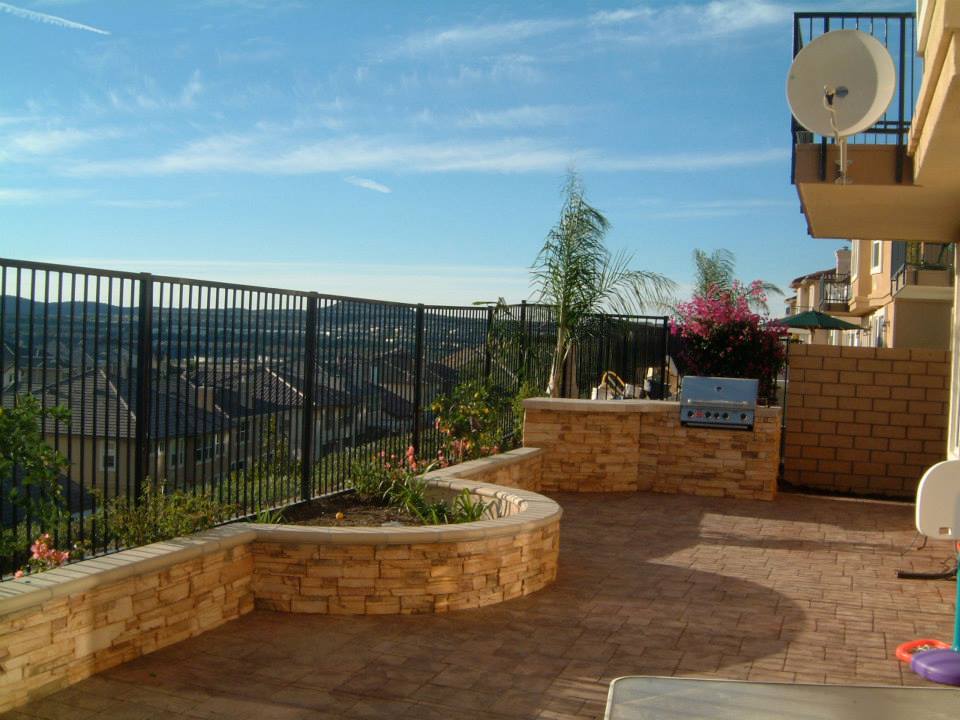
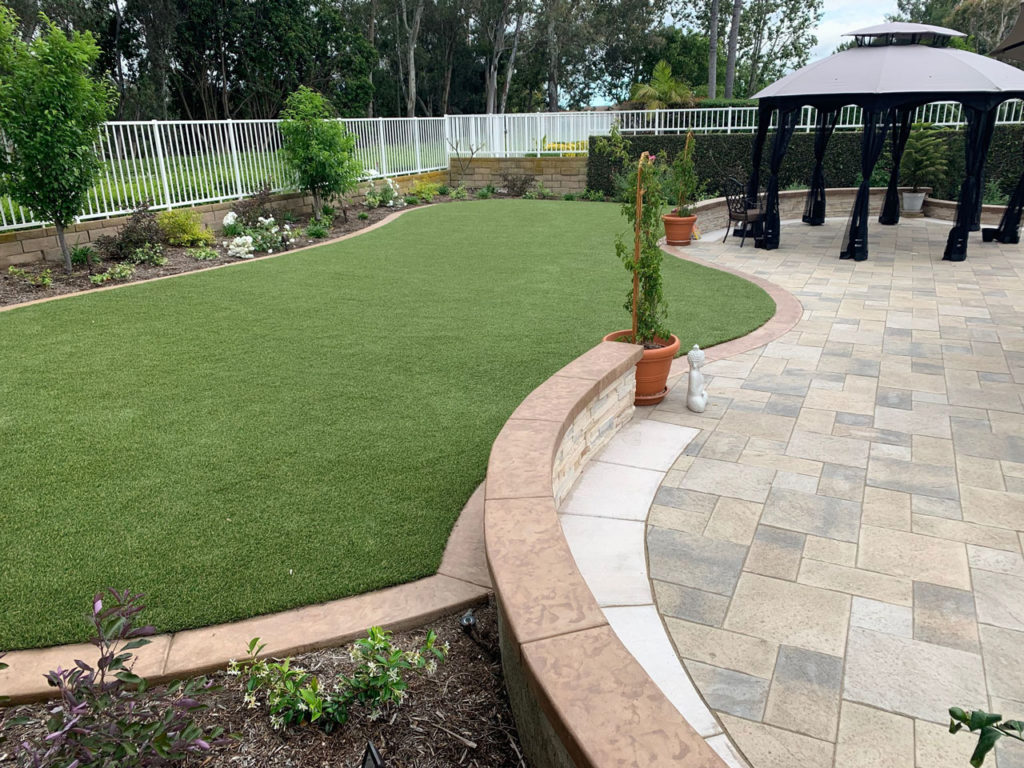
Concrete paver patios run $15 to $25 per square foot. Brick and clay paver patios run $17 to $28 per square foot. A 400-square-foot concrete paver patio totals approximately $9,200 on average. A real Irvine HOA project — a 350-square-foot concrete paver patio with a small seating wall — came in at $9,500 ($27 per square foot). The slightly higher cost was driven by the seating wall addition and the contractor's premium for navigating restricted HOA work hours. It passed inspection on the first attempt.
Walkways are often the most misunderstood line item in a paver budget. Despite being smaller in area, they frequently carry a higher per-square-foot cost than patios. Curves require intricate cutting. Equipment setup costs are fixed regardless of project size. For interlocking pavers used in pathway applications, expect to pay at the mid-to-upper end of that range due to the precision required.
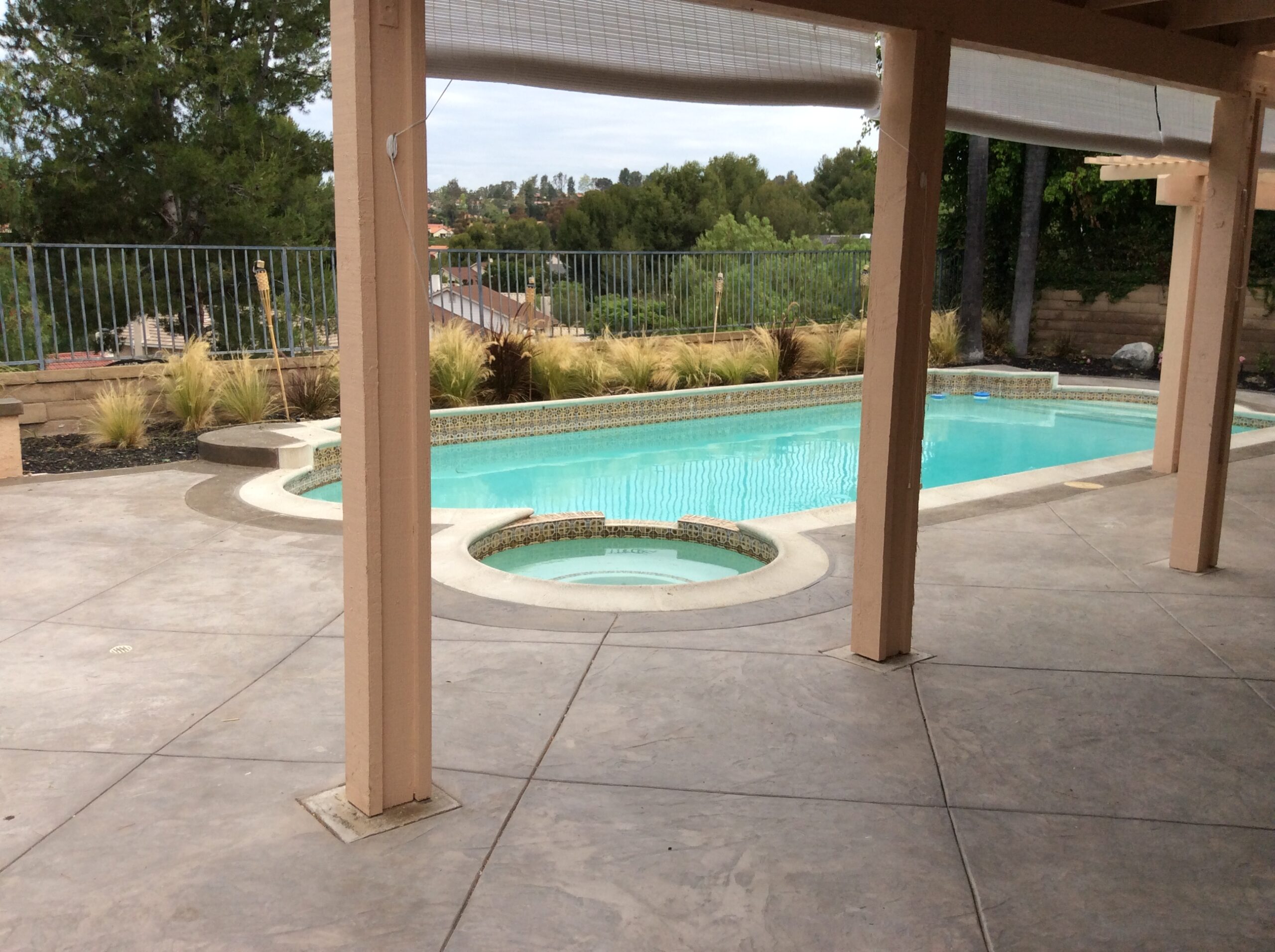
This is the highest-cost paver application category. Travertine pool decks run $22 to $45 per square foot. Porcelain paver outdoor living areas run $25 to $50 per square foot. Premium materials are specified here for functional reasons, not just aesthetics. Travertine and porcelain offer slip resistance and heat reflection, both of which matter on a Southern California pool deck. A real Newport Beach example: an 800-square-foot travertine pool deck cost $28,000 ($35 per square foot), including full demolition of the existing cracked concrete, regrading, and a new base.
The low bid at $18,000 proposed laying pavers over the existing cracked surface without addressing the underlying problem. The homeowner avoided future settling and cracking by not taking it.
Within any project type, material and design decisions determine where you land in the cost range. These choices compound quickly.
Standard concrete pavers run $3 to $8 per square foot for material. Premium natural stone or porcelain runs $15 to $25 per square foot — up to three times more for the same area. Permeable paver systems run $18 to $35 per square foot installed. They carry a premium, but California's environmental focus and HOA stormwater requirements make them the required or preferred choice in a growing number of Orange County communities.
Herringbone, basket weave, circular designs, and decorative borders all require more cuts, more time, and more material than a standard running bond. At $50 to $80 per hour for skilled Orange County labor, complexity is expensive. The more intricate the layout, the higher the installed cost — regardless of the material price per square foot. If the budget is tight, a clean, simple pattern in a premium material almost always delivers better value than a complex pattern in a budget material. For decorative surface options, stamped concrete is also worth evaluating as a cost-effective alternative for certain applications.
Site conditions are the most common source of variance between an initial estimate and a final invoice. Orange County properties frequently present drainage, access, and soil challenges that do not show up in a basic per-square-foot quote.
California law prohibits altering grading in ways that direct water runoff onto neighboring properties. HOAs enforce this with detailed drainage plan requirements. French drains, catch basins, and regrading add to the base project cost and show up as a separate 5% to 10% line item on any project where drainage is a factor. Most Orange County HOAs also require hardscaping to maintain a 3 to 5 foot setback from property lines to preserve drainage corridors, which can constrain usable installation areas and require design revisions.
If a skid steer or other machinery cannot access the site, all materials must be moved by hand or wheelbarrow. That adds substantial labor hours to any project. It is one of the most consistently underestimated cost variables on Orange County's compact, walled residential properties. Coastal properties in Newport Beach and Laguna Beach also require material specifications that inland sites do not. Salt air degrades standard concrete pavers faster than premium stone or porcelain, making material upgrades a durability investment rather than a luxury choice on coastal lots.
Planning your full outdoor environment around site-specific conditions — including how seasonal planting interacts with new hardscape surfaces — is part of a well-executed project. See seasonal landscaping guidance for Orange County for how softscape and hardscape work together.
Most paver projects expand once homeowners see the space taking shape. Knowing add-on costs before construction starts is the difference between a controlled budget and an open-ended one.
Vertical hardscape elements carry a cost premium on top of the base paver installation rate. The Irvine patio example was priced above the standard patio range specifically because of the seating wall addition. Steps, raised borders, and decorative edging all add labor and material cost outside the standard per-square-foot figure. Budget for them as separate line items, not as part of the surface area calculation.
Gas line connections for fire features add approximately $3,000 when installed during initial construction. Retrofitting them through completed hardscape costs significantly more. Electrical rough-in for landscape lighting follows the same logic. Planning these integrations before the patio or driveway is laid is the most cost-efficient approach. A well-designed shade structure also integrates more cleanly when planned alongside the hardscape rather than added later.
A realistic budget is built before anyone is on site. Homeowners who go over budget almost always skip the line-item planning step.
Every paver project budget must include: materials (35% to 45%), labor (30% to 40%), site prep and excavation (10% to 20%), drainage and base (5% to 10%), and permits and miscellaneous (2% to 5%). Total installed cost benchmarks by project type: concrete paver patio $15 to $25 per square foot; brick and clay patio $17 to $28; natural stone patio $20 to $45; paver walkway $15 to $28; paver driveway $20 to $40; travertine pool deck $22 to $45; porcelain outdoor living area $25 to $50; permeable paver system $18 to $35. Add a 10% to 15% contingency to every number on that list.
If one bid is 30% lower than the others, it is a red flag. Low bids typically omit excavation depth, base material, or drainage infrastructure. They may also reflect unlicensed or uninsured labor. A contractor who asks you to pull the permit as an owner-builder is often avoiding scrutiny because they are unlicensed or doing substandard work. California law requires a CSLB-licensed contractor for any project exceeding $500 in labor and materials. For paver work, that is typically a C-27 (Landscaping) or C-8 (Concrete) license. Always verify license status on the CSLB website before signing anything.
Not all paver projects return equally. Prioritizing by ROI and daily utility helps when the full wish list exceeds the available budget.
Paver patios and driveways are the highest-frequency use surfaces on any residential property. They define primary circulation, first impressions, and gathering areas. In Southern California, paver patios and driveways return up to 90% ROI, the strongest return of any structural outdoor feature category. That makes them the most financially defensible starting point in any hardscape investment plan.
Upgrading to natural stone or porcelain is justified for pool decks and high-visibility outdoor living areas where slip resistance, heat reflection, and coastal durability matter. Permeable paver systems are worth the premium wherever HOA stormwater compliance or lot coverage limits apply. For standard patios and driveways in inland locations, mid-range concrete pavers in a clean pattern deliver strong durability and ROI without the premium material price.
Any paver project involving permits, drainage engineering, HOA approvals, or premium materials needs professional planning. In Orange County, the cost of getting this wrong far exceeds the cost of getting it right.
HOA architectural review takes 30 to 45 days on average in Orange County. A typical project runs 22 to 24 weeks from initiation to completion. Planning and design consultation begins at week zero. Paver installation does not start until around week 17. Projects that skip the design phase and submit incomplete applications face revision requests that reset the clock entirely. The site plan required for HOA submission must be to scale, show all property lines and existing structures, and include a drainage plan — documentation that also functions as the construction blueprint.
Does the estimate include all permit fees, HOA review costs, and utility connections? What site conditions were assessed and what could change the budget if found during excavation? Are materials specified by brand, color, and size, or are substitutions possible? What is the down payment request? California law caps contractor down payments at 10% of project cost or $1,000, whichever is less. Does the contractor offer a minimum 1 to 3 year labor warranty in addition to the manufacturer's material warranty?
On a sample 400-square-foot paver patio, a low bid of $8,500 carried 6 of 8 red flags including no written contract, no drainage plan, no permit pulling, and no warranty. A fully vetted contractor bid $17,800 with zero red flags and full scope coverage. The lowest number is rarely the lowest risk.
Orange County paver installation costs range from $15 per square foot for a standard concrete patio to $50 per square foot for a premium porcelain outdoor living area. Every budget needs a 10% to 15% contingency. Every contractor must be CSLB-licensed. Every project in a master-planned community requires HOA approval before construction begins. The homeowners who stay on budget and get lasting results are the ones who plan thoroughly, specify correctly for their site, and vet their contractor before signing.
Signature Landscape has been building exceptional hardscape environments across Orange County for over 38 years. From paver patios and driveways to complete outdoor living spaces, the team brings licensed expertise, local code knowledge, and proven craftsmanship to every project. Request a free quote and start building the outdoor space your property deserves.
Schedule A Consultation