Call our Professional Contractors!
(949) 859-9969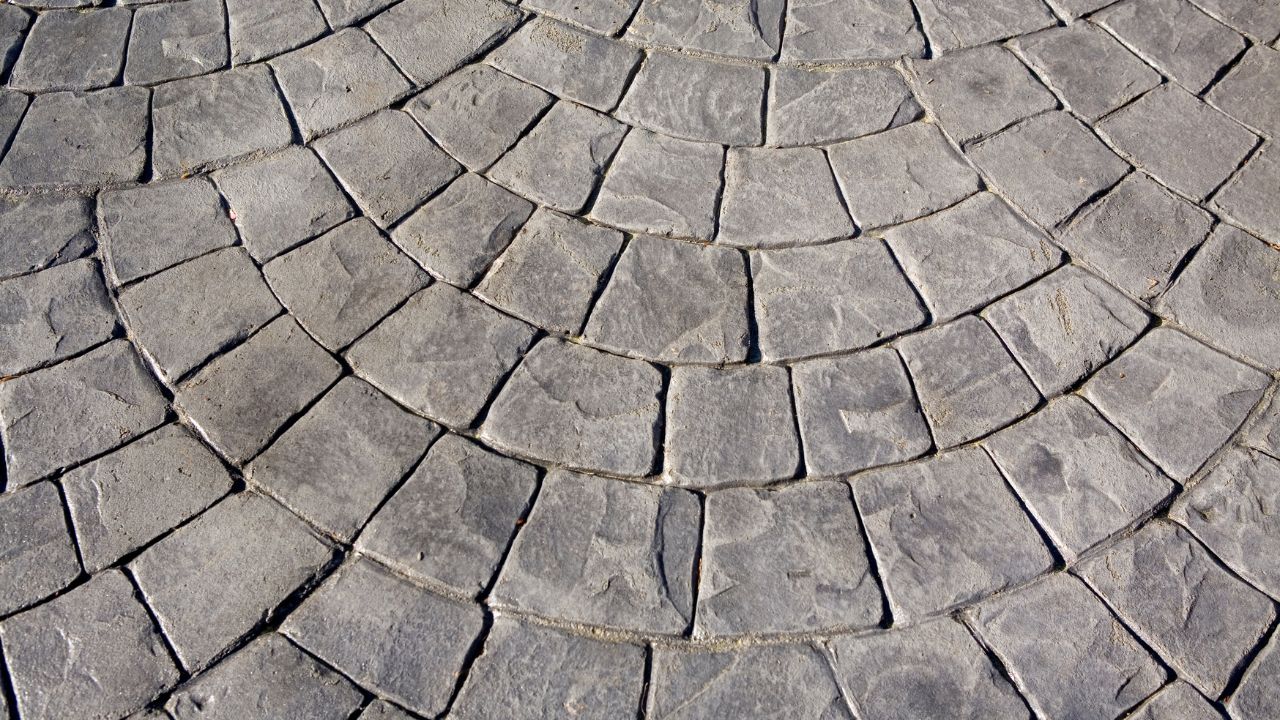
Key Takeaways:
Choosing the wrong hardscape material in Orange County is an expensive mistake. The local climate, seismic activity, and coastal conditions create performance demands that most generic material guides ignore. This article compares stamped concrete, pavers, and natural stone across cost, durability, maintenance, and best-fit applications so you can make a confident, informed decision before a single dollar is spent.
These are the three most common hardscape surface materials used on OC driveways, patios, pool decks, and walkways. Each solves different problems at different price points.
Stamped concrete is poured concrete pressed with molds to mimic stone, brick, or wood. It creates a seamless, customizable surface. Basic patterns run $8–$12/sq ft installed in Orange County. Custom multi-color designs reach $15–$30/sq ft. Properly reinforced slabs last 15–25 years. Maintenance is simple: sweep, rinse, and reseal every two to three years.
The tradeoff is repairability. Matching the original color and pattern after years of weathering is difficult. Repairs are rarely seamless, and the surface is a single rigid slab.
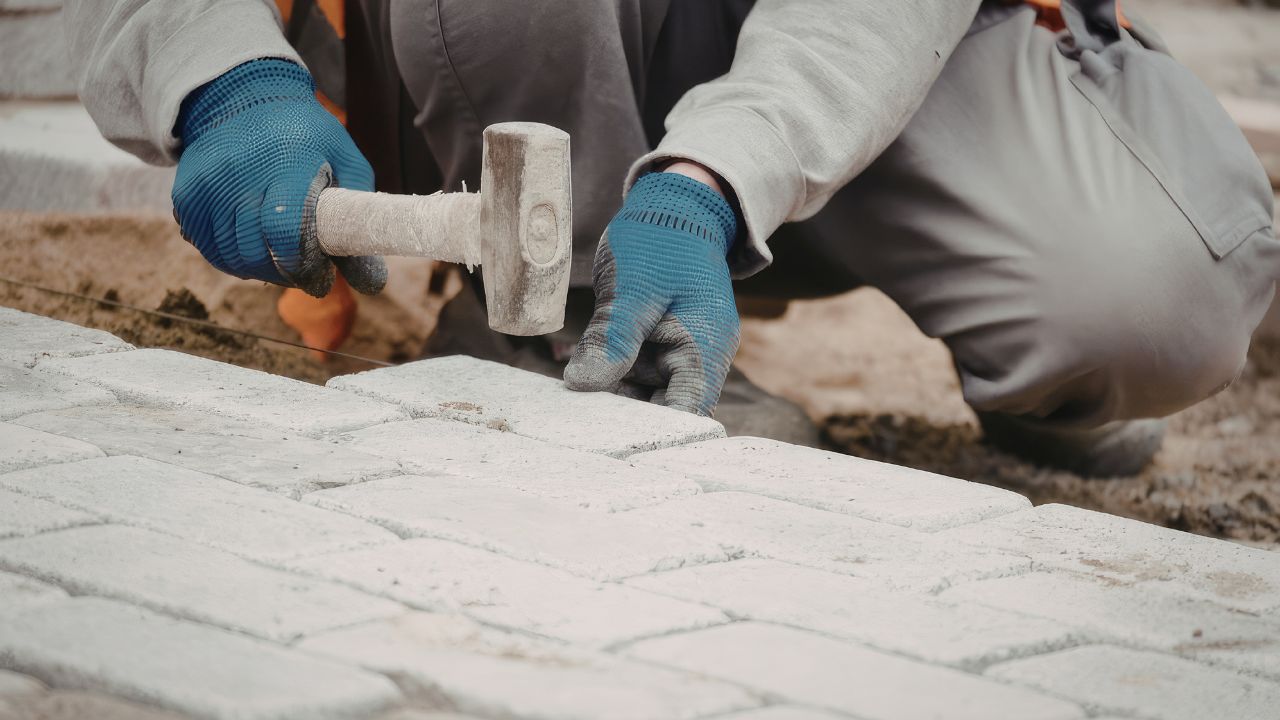
Interlocking pavers are individual concrete, brick, or clay units that lock together to form a surface. Concrete pavers install for $15–$18/sq ft. Brick pavers run $16–$20/sq ft. Premium or natural stone paver installations reach $21–$28/sq ft. Concrete pavers last 20–30 years. Natural stone pavers exceed 50 years with proper care.
The biggest advantage is unit-level repairability. One cracked paver lifts out and replaces without disturbing the rest. Permeable systems also process over two inches of rainfall per hour, which helps with OC drainage requirements and MWELO compliance.
Natural stone offers longevity no manufactured product matches. Flagstone installs for $15–$25/sq ft and provides excellent slip resistance. Granite pavers run $20–$35/sq ft, resist UV fading, and handle direct sun better than most materials. Slate and bluestone both offer tough, non-slip surfaces with premium aesthetics. Typical lifespan exceeds 50 years. With proper care, 100-plus years is achievable.
The investment is higher upfront, but the total cost of ownership over decades is often lower than materials that need replacement every 15–25 years.
Performance differs significantly across strength, design, and installation. Understanding these differences prevents costly material mismatches.
Interlocking pavers are approximately four times stronger than a standard concrete slab under compressive loads. Their segmented design flexes during seismic events instead of cracking. This matters in Orange County. Southern California is one of the most seismically active regions in the country, and monolithic concrete slabs are the most vulnerable surface type when the ground shifts.
Stamped concrete is more prone to large structural cracks under seismic stress. Control joints reduce this risk but do not eliminate it. Segmental Retaining Wall systems such as Allan Block and Versa-Lok are specifically engineered with seismic coefficients for OC conditions.
Stamped concrete offers the widest pattern range. Ashlar Slate, Random Flagstone, and Cobblestone are popular OC choices. Heavily textured patterns also improve surface grip. Non-slip additives mixed into the sealer improve safety on smoother finishes.
Pavers come in a wide range of colors and styles. SRW blocks replicate natural stone at lower cost. Natural stone offers what no manufactured product can: genuine organic variation in color and texture. Travertine complements Mediterranean architecture. Granite projects a refined, polished aesthetic. Slate delivers a bold, contemporary palette.
Stamped concrete requires rebar or fiber mesh reinforcement plus a thoroughly compacted stone base. Skipping either shortens the lifespan significantly. All retaining walls require engineered drainage, specifically gravel backfill and perforated pipe, to prevent hydrostatic pressure buildup, which is the leading cause of wall failure.
OC permit requirements apply to driveways over 100 sq ft, retaining walls over 4 feet in height, walls with sloping backfill, and walls supporting a surcharge such as a driveway. HOA architectural review adds 30–60 days to the project timeline. Knowing this before selecting materials prevents redesigns mid-project.
Cost is only part of the picture. Maintenance and lifespan determine the actual return on investment. These numbers give you the full view.
Orange County labor runs 15–25% above national averages across all material categories. Stamped concrete is typically 30–50% less than premium paver or natural stone alternatives, making it the most accessible entry point. Travertine pavers install for $15–$27/sq ft. Porcelain pavers run $28–$45/sq ft, the highest standard tier.
Real project benchmarks provide useful anchors. A 1,800 sq ft Laguna Niguel project combining a travertine pool deck and Belgard concrete patio pavers totaled approximately $42,000, or about $23/sq ft blended. A 600 sq ft granite driveway in Newport Beach installed at approximately $18,000, or $30/sq ft.
Porcelain pavers require zero sealing. With roughly 0.5% moisture absorption, they are virtually impervious to pool chemicals and salt air. This is the lowest maintenance burden available for any OC hardscape surface. Travertine needs resealing every two to three years to protect against pool chemical staining. Flagstone, slate, and bluestone need UV-resistant sealers applied every two to five years to preserve both appearance and structural integrity.
Stamped concrete's biggest long-term liability is repair cost. Matching original color and pattern years after installation requires professional re-application and is rarely perfect. Pavers avoid this entirely. A single damaged unit is replaced in isolation without touching the surrounding surface.
OC properties with professionally designed outdoor spaces command offers 8–12% higher than comparable homes without them. General hardscaping returns 20–30% ROI. Outdoor kitchens and fire features return 67–80%. Drought-resistant landscaping paired with permeable hardscapes delivers 110–130% ROI, the highest return category in the hardscape asset class.
Converting 1,000 sq ft of traditional lawn to xeriscaping with permeable pavers costs $5,000–$10,000 and can add $12,000–$15,000 to property value in Newport Beach and Laguna Beach. The MWDOC Turf Replacement Program offers $2/sq ft rebates on turf removed, directly offsetting project costs.
OC's combination of intense UV, coastal salt air, and seismic activity is unlike most other US markets. Material performance here depends on understanding these specific conditions.
Orange County's UV index frequently reaches "very high" or "extreme" (10+). Dark surfaces can hit 140–160°F when air temperature exceeds 95°F. Light-colored materials stay 10–20°F cooler. Under peak OC sun, measured surface temperatures by material tell a clear story: travertine reaches approximately 105°F, light porcelain 108°F, light concrete pavers 118°F, and dark concrete pavers 135–145°F. For a pool deck guide specific to OC heat conditions, material color and composition are the most important variables.
Coastal communities including Newport Beach, Laguna Beach, Huntington Beach, and Dana Point face accelerated deterioration from salt air. Granite and porcelain resist salt the best and require the least maintenance in these environments. UV-resistant penetrating sealers applied on a regular cycle are not optional maintenance in Orange County. They are essential to achieving the rated material lifespan.
The California Geological Survey maps seismic hazard zones across OC for liquefaction and earthquake-induced landslide risk. These maps should inform every hardscape planning decision, particularly retaining walls. Monolithic slabs crack under seismic stress. Interlocking systems flex and redistribute movement instead.
Permeable hardscapes allow rainwater to filter into the water table, reducing urban runoff and supporting water conservation under California's MWELO. Many OC retaining walls older than 20 years are actively failing because they were built without modern geotechnical and seismic design principles. Professional structural assessment is warranted for any wall supporting a driveway, structure, or sloped backfill. OC's fire-safe landscaping standards also intersect with hardscape planning, particularly for properties in wildfire-adjacent areas. The 2025 Orange County fire-safe landscaping guide covers how hardscape design integrates with defensible space requirements.
The right material depends on the application. No single material is ideal everywhere on a property.
For pool decks, heat management and slip resistance take priority. Travertine's DCOF typically exceeds 0.50, the minimum safe threshold for wet pool surfaces. Porcelain's DCOF exceeds 0.60, rated R11 or R12, the highest available in standard pool deck materials. Concrete pavers with texture, tumbling, or sandblasting reach DCOF 0.50–0.55. Experienced OC contractors strongly advise against dark concrete pavers around pools. Surface temperatures of 135–145°F create burn risk for bare feet.
For coastal properties and saltwater pools, porcelain is the first recommendation. For budget-conscious interior patios, stamped concrete performs reliably. For driveways, concrete pavers handle compressive load better than any alternative in their price range. For walkways where aesthetics matter, flagstone creates organic, naturally flowing paths that manufactured materials cannot replicate.
Poured concrete retaining walls suit contemporary and minimalist architecture. Their clean, continuous surface reads as modern. This is why a Newport Beach client chose this material for a street-facing wall on a contemporary home. Travertine pairs naturally with Mediterranean, Spanish Colonial, and Tuscan styles common across OC's coastal neighborhoods. SRW blocks are versatile across modern, traditional, and transitional vocabularies and can credibly mimic natural stone at lower cost.
Natural stone is the only material that delivers genuine, timeless differentiation. No manufactured product fully replicates its variation, depth, or aging character.
The right choice depends on your budget, your site, and how you plan to use the space. Use this framework to narrow the decision.
Start with the application and its specific performance requirements. A pool deck prioritizes heat and slip resistance. A driveway prioritizes compressive strength. A retaining wall prioritizes structural integrity and seismic performance. Then assess your microclimate. Properties within approximately one mile of the coast should prioritize salt-resistant materials regardless of budget. South-facing properties need light-colored materials and UV-resistant sealers.
Evaluate total cost of ownership, not just the installed price. Factor in sealing cycles, repair costs, and eventual replacement. A material at $28/sq ft with a 50-year lifespan can be more economical than a $12/sq ft material requiring full replacement in 15 years. Review HOA CC&Rs and city permit requirements before purchasing materials. These can eliminate certain options entirely.
Prioritize durability when the surface will take heavy use, vehicular traffic, or seismic exposure. Natural stone's 50–100-plus year lifespan makes the higher upfront cost defensible on a long-horizon investment. Prioritize maintenance simplicity when the owner has limited time for upkeep. Porcelain requires no sealing, resists all pool and salt exposure, and holds its appearance for 20–30-plus years without intervention. Prioritize aesthetics when the space is a primary entertainment or living area. Natural stone creates a level of visual richness that manufactured materials cannot match.
Never choose timber for any structural retaining wall application in Orange County. Heat, coastal moisture, UV, and termite exposure lead to rapid degradation. Timber walls typically last only 10–20 years and have poor seismic performance. They are acceptable only for low, decorative garden borders.
Single-material designs often compromise performance somewhere on the property. The best OC projects match each material to its specific functional zone.
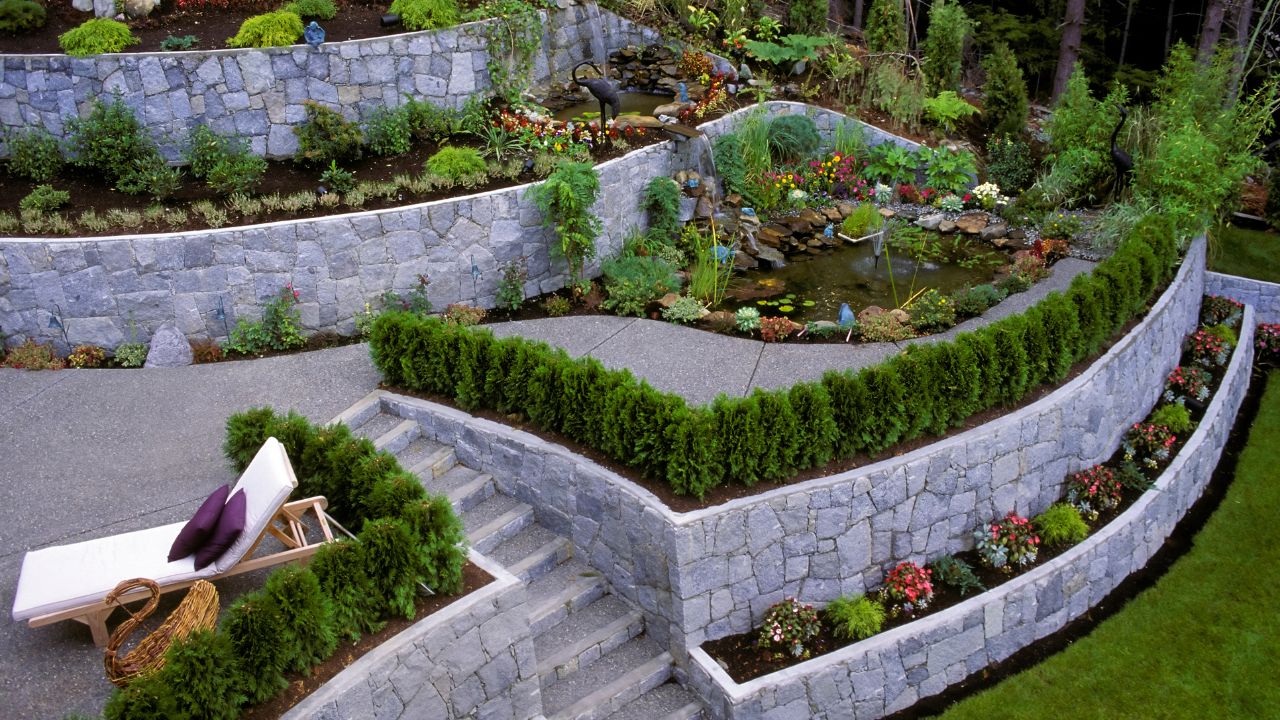
A Laguna Niguel project illustrates this well. Travertine was chosen for the pool deck for its heat dissipation and natural aesthetic. Belgard concrete pavers covered the main entertaining patio for durability, seismic flexibility, and easy unit replacement. The total 1,800 sq ft project blended the strengths of both materials. An Irvine project used Allan Block SRW for terraced retaining walls, decomposed granite for permeable pathways, and stamped concrete for a defined seating area. Three materials, three distinct performance roles, one cohesive design.
Combining materials allows each surface to perform optimally within its specific conditions. Forcing one material to serve multiple conflicting performance requirements across an entire property is a common and costly mistake.
A Newport Beach poured concrete retaining wall at 45 linear feet and 5 feet in height required engineered structural drawings and a city building permit. Total cost was approximately $14,500. A non-professional contractor cannot navigate this correctly, and an improperly engineered wall supporting a driveway surcharge is a structural liability. The Irvine contractor also secured MWDOC Turf Replacement rebates that partially offset the project cost, an outcome that depends on knowing the process.
Retaining walls older than 20 years across OC are actively failing because they lack modern seismic and geotechnical engineering. For walls over 6 feet or those supporting structures, a licensed structural engineer and a properly engineered system are the professional standard, not a recommendation.
The wrong material in OC's climate is an expensive mistake. The right one, installed correctly, adds decades of value and daily enjoyment to your property.
Signature Landscape has spent over 38 years making exactly these decisions for Orange County homeowners, across more than 1,000 completed projects. If you are ready to get a clear material recommendation for your specific site, request a free consultation today.
Schedule A Consultation