Call our Professional Contractors!
(949) 859-9969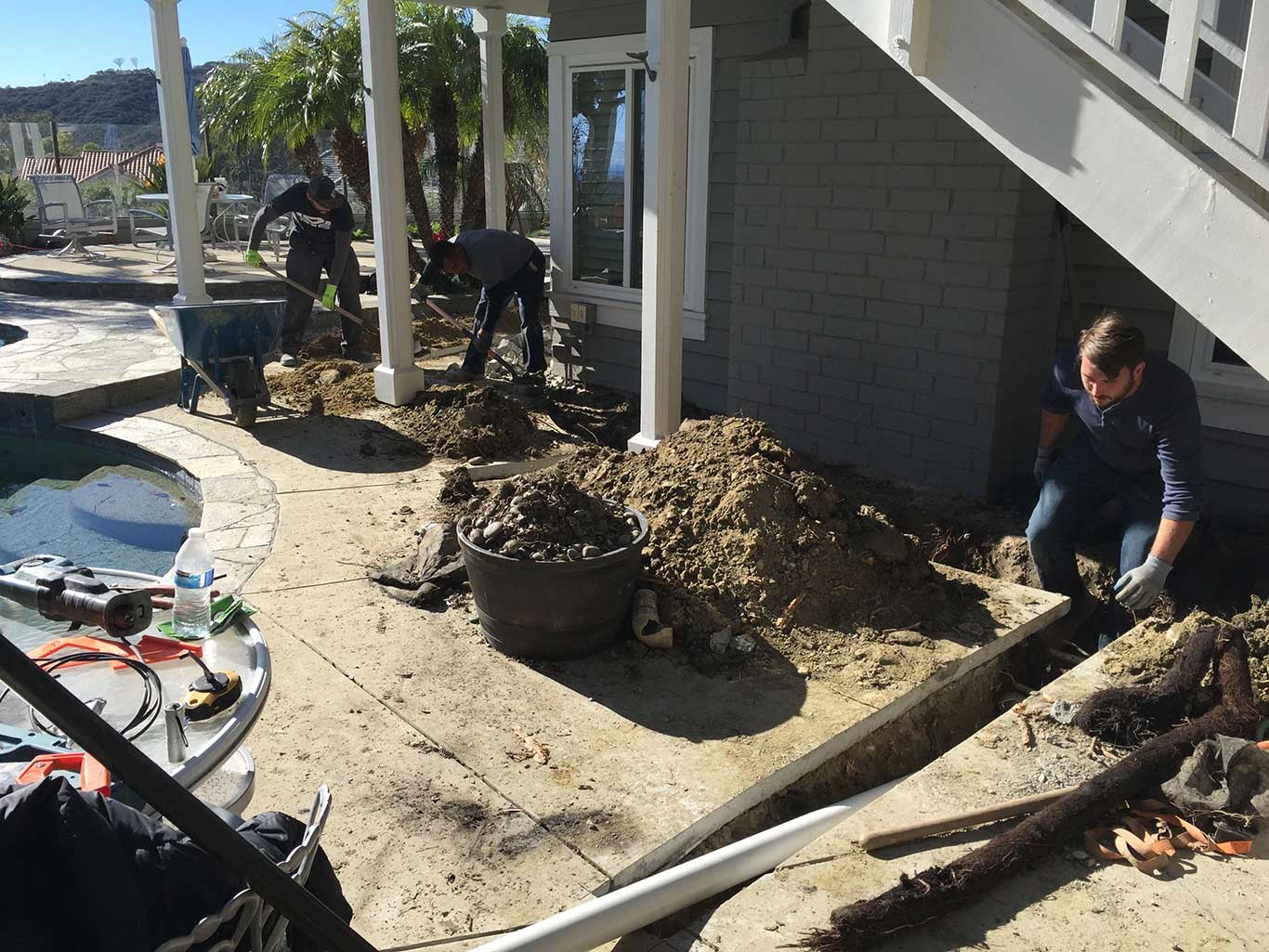
Key Takeaways
Basement flooding destroys property, threatens structural integrity, and creates health hazards from mold growth. While temporary fixes mask symptoms, permanent drainage solutions address root causes, eliminating the hydrostatic pressure that forces water through concrete walls.
This comprehensive guide explains how professional landscape drainage systems protect your basement for decades, from initial design through long-term maintenance.
Basement flooding stems from water accumulating around your foundation, creating hydrostatic pressure that forces water through concrete walls and floors. The primary culprits include negative grading that directs water toward the structure, clogged gutters, foundation cracks, and inadequate drainage systems. Heavy rainfall compounds these issues, overwhelming undersized or poorly maintained systems.
Landscape drainage systems prevent flooding by eliminating hydrostatic pressure before it builds. Exterior solutions, footing drains, proper grading, and downspout extensions intercept water at the source and redirect it away from the foundation. This approach stops basement water after rain from ever reaching basement walls, unlike interior systems that only manage water after it penetrates. The stakes are high: foundation repairs from chronic flooding can exceed $10,000, far surpassing the cost of proper drainage repair installation.
Five primary systems protect basements from water intrusion, each serving distinct functions:
| System Type | Key Features | Pros and Cons | Common Use Cases |
| Footing Drains | 4-inch perforated pipe at foundation footing, wrapped in filter fabric | Pros: Relieves hydrostatic pressure, 30-50+ year lifespanCons: $40-$100/linear foot | Required for all basement protection |
| French Drains | Perforated pipe in gravel-filled trench | Pros: Versatile, 30-50+ yearsCons: Susceptible to root intrusion | Saturated yards, sloped properties |
| Surface Drains | Catch basin with grate, solid pipe | Pros: Traps debris, prevents clogsCons: $300-$500 per unit | Patios, driveways, low spots |
| Sump Pumps | Mechanical pump in basement pit | Pros: Active water removalCons: Requires power, maintenance | Discharge point for footing drains |
| Downspout Extensions | Solid pipe 4-6 feet from foundation | Pros: Low cost ($5-$15 DIY)Cons: 10-20 year lifespan | All homes; first line of defense |
Surface drains (catch basins) collect pooling water through grated inlets and channel it into buried pipe systems. The basin traps leaves and debris, preventing downstream clogs. Sump pumps serve as the final discharge point for footing drain systems, actively removing water that accumulates at the foundation level, critical for homes below the water table or without gravity outlets.
Downspout extensions represent your first defense. Roof runoff concentrates massive water volumes at foundation walls; extensions move this water 4-6 feet away using solid, smooth-walled pipe. Corrugated pipe clogs easily and crushes under soil weight; always use PVC or HDPE for permanent installations. For properties on slopes, retaining walls can work in conjunction with drainage systems to manage water flow and prevent soil erosion around the foundation.
Effective landscape drainage system design starts with site assessment: identify where water flows during heavy rain, measure existing grades, and test soil permeability. Ground must slope away from the foundation at 5% minimum (6 inches over 10 feet). All subsurface pipes require 1% slope (1/8 inch per foot) for gravity flow. Sandy or loamy soils support infiltration systems; clay-heavy soils need amendments or systems that discharge to storm sewers.
| Factor | System Selection | Critical Specifications |
| Flooding History | Recurring basement seepage: Footing drains + exterior waterproofingYard ponding: French drains, catch basins | Footing drains positioned below basement slab level |
| Soil Type | Sandy/loamy: Infiltration-based systemsClay: Pipe discharge to outlet | Clay soils require heavy amendment or sealed pipe systems |
| Topography | Sloped lots: Curtain drains uphill from houseFlat lots: Surface grading, area drains | Curtain drains intercept groundwater 2-3 feet deep |
Professional installation costs more but includes infiltration testing, proper slope verification, and filter fabric installation, three elements commonly skipped in DIY projects that lead to system failure. Warranties and engineering design justify the expense for basement-critical applications. DIY works for simple downspout extensions and surface grading; foundation drainage solutions warrant professional oversight.
Proper installation requires specific materials and precise execution. The core components work together as a system: perforated pipe collects groundwater, geotextile fabric prevents soil intrusion, clean aggregate provides drainage pathways, and solid pipe conveys water to discharge points.
| Tool/Material | Purpose/Use | Critical Specifications |
| Perforated Pipe | Collects groundwater | 4-inch diameter, holes facing down |
| Solid Pipe | Conveys surface water from catch basins | Smooth-walled PVC or HDPE only, never corrugated |
| Geotextile Filter Fabric | Prevents clogging | Wraps pipe and gravel to block fine soil particles |
| Gravel/Crushed Stone | Drainage medium | Clean, coarse aggregate (no fines) |
Installation follows a specific sequence: excavate trenches to proper depth (footing drains at foundation footing level, curtain drains 2-3 feet deep), lay perforated pipe at 1% minimum slope, surround with gravel, wrap entire assembly in filter fabric, backfill, and test flow. The 1% slope (1/8 inch per foot) is non-negotiable, standing water in pipes leads to sediment accumulation and eventual clogging. Call 811 before digging to mark utility lines.
Testing confirms success: run water through the system and verify it exits at the discharge point within minutes. Ponding or slow drainage indicates insufficient slope or blockages requiring correction before backfilling. For properties requiring additional structural support, property walls can provide both aesthetic and functional benefits while directing water away from vulnerable areas.
Professional installation eliminates the four most common failure modes: improper slope, missing filter fabric, corrugated pipe, and inadequate downspout extensions. These mistakes account for 80% of premature system failures, often appearing 2-5 years post-installation when DIY projects are forgotten. Professionals use smooth-walled PVC or HDPE pipe exclusively, calculate exact slopes using laser levels, and perform infiltration testing to size systems correctly.
The expertise justifies the premium. Contractors provide warranties covering workmanship for 1-5 years, conduct site inspections to identify non-obvious water sources, and design systems that account for soil permeability variations across the property. They also handle permitting and code compliance, critical for footing drains that affect structural elements. When properly installed, these systems deliver 30-50+ year lifespans with minimal maintenance.
Professional services include complete site assessment, infiltration testing (required for clay soils), engineered system design, excavation, installation, flow testing, and final inspection. Many offer maintenance contracts for periodic flushing and inspection, extending system longevity beyond the typical range. Understanding how retaining walls can protect your home from water damage also helps professionals design comprehensive drainage solutions that address multiple water management challenges.
Installation costs vary significantly by system type and site conditions. Footing drains represent the largest investment but provide essential basement protection:
| System Type | Cost Range | Longevity | Annual Cost |
| Footing/French Drain | $40-$100/linear foot | 30-50+ years | $213/year (highest) |
| Curtain Drain | $10-$25/linear foot | 30-50+ years | , |
| Catch Basin | $300-$500 per unit | 30-50+ years | , |
| Downspout Extension | $5-$15 (DIY) | 10-20 years | $12/year (lowest) |
| Surface Regrading | Varies widely | 50 years (longest) | , |
The cost-per-year analysis reveals surprising value: downspout extensions deliver basement protection for $12 annually, while comprehensive footing drain systems cost $213 per year over their lifespan. However, footing drains are non-negotiable for homes with chronic basement seepage, skipping them to save money leads to foundation repairs exceeding $10,000.
Accurate estimates require property evaluation: measure linear feet of foundation perimeter, identify low spots needing catch basins, assess soil type (clay requires amendments), and verify accessibility for excavation equipment. Request quotes from 3-5 contractors and compare scope carefully, lowest bids often omit filter fabric or use corrugated pipe.
Additional costs include permits ($50-$200), soil testing ($300-$500), and unexpected repairs if excavation reveals foundation damage. Clay-heavy soils may require amendments or alternative discharge strategies, adding $500-$2,000 to project costs.
Maintenance determines whether your drainage system reaches its 30-50+ year potential or fails within a decade. The most critical task occurs annually: clean gutters and downspouts, verify extensions remain connected and discharge properly, and clear all visible grates on catch basins and trench drains. These simple checks prevent 90% of system failures caused by debris accumulation.
Deeper maintenance follows a tiered schedule. Every 2-3 years, inspect catch basins and remove accumulated sediment, typically 2-6 inches of silt and organic matter that reduces storage capacity. Every 5-10 years, hire professionals to flush subsurface systems (French drains, footing drains) using high-pressure water jetting, removing root intrusion and sediment before pipes clog completely. Monitor foundation grading continuously; settled soil creates negative slopes that direct water toward the house, requiring periodic addition of topsoil to restore the 5% grade.
Warning signs demand immediate attention: water pooling near the foundation indicates slope failure or outlet blockage, both requiring urgent correction. Blocked outlets, clogged with leaves, ice, or debris, cause entire systems to fail by preventing discharge. A $50 outlet cleaning prevents thousands in foundation damage. Regular maintenance achieves the maximum expected 30-50+ year lifespan and prevents the $10,000+ foundation repairs that result from neglected drainage. Proper yard drainage near basement areas is especially critical for maintaining system effectiveness.
Waterproofing membranes represent the primary alternative, though they work best when combined with drainage rather than replacing it. Applied directly to foundation walls, bituminous coatings and sheet membranes create a physical barrier preventing water contact with concrete. This approach stops water penetration but doesn't address hydrostatic pressure, the force that eventually overwhelms even the best membranes.
The most robust solution integrates both: a waterproof membrane applied to foundation walls with footing drains installed at the base. The membrane serves as the first line of defense, blocking direct water contact, while the drain system serves as the second line, eliminating hydrostatic pressure by keeping the surrounding soil de-pressurized. This combination delivers the highest reliability for chronic basement seepage.
Supplementary improvements include sealing foundation cracks (temporary fix without addressing water source), installing or upgrading sump pumps (treats symptoms, not causes), improving surface grading to 5% slope over 10 feet, and installing permeable pavers to reduce runoff volume. However, none of these alternatives eliminates the need for proper exterior drainage; they enhance it. Properties with serious flooding history require comprehensive systems: membrane waterproofing, footing drains, corrected grading, and extended downspouts working together to eliminate hydrostatic pressure completely.
Professional drainage systems stop basement flooding by eliminating hydrostatic pressure at its source, before water reaches foundation walls. Expertise matters: properly designed systems avoid the installation mistakes that cause 80% of failures (improper slope, missing filter fabric, corrugated pipe, inadequate extensions). When installed correctly and maintained regularly, these systems deliver 30-50+ year lifespans, far exceeding the cost of foundation repairs they prevent.
The data proves the value: proper grading alone achieves 88% average water volume reduction, converting negative slopes (water flowing toward the house) into positive slopes (water flowing away). Annual maintenance and 5-10 year professional flushing extend system longevity to maximum potential. The most effective approach combines multiple layers: waterproof membranes on foundation walls, footing drains at the base, 5% surface grading away from the structure, and downspout extensions discharging 4-6 feet from the foundation. Together, these components relieve hydrostatic pressure and keep basements permanently dry.
Ready to protect your basement from flooding? Request a free drainage consultation and discover the right solution for your property.
Schedule A Consultation