Call our Professional Contractors!
(949) 859-9969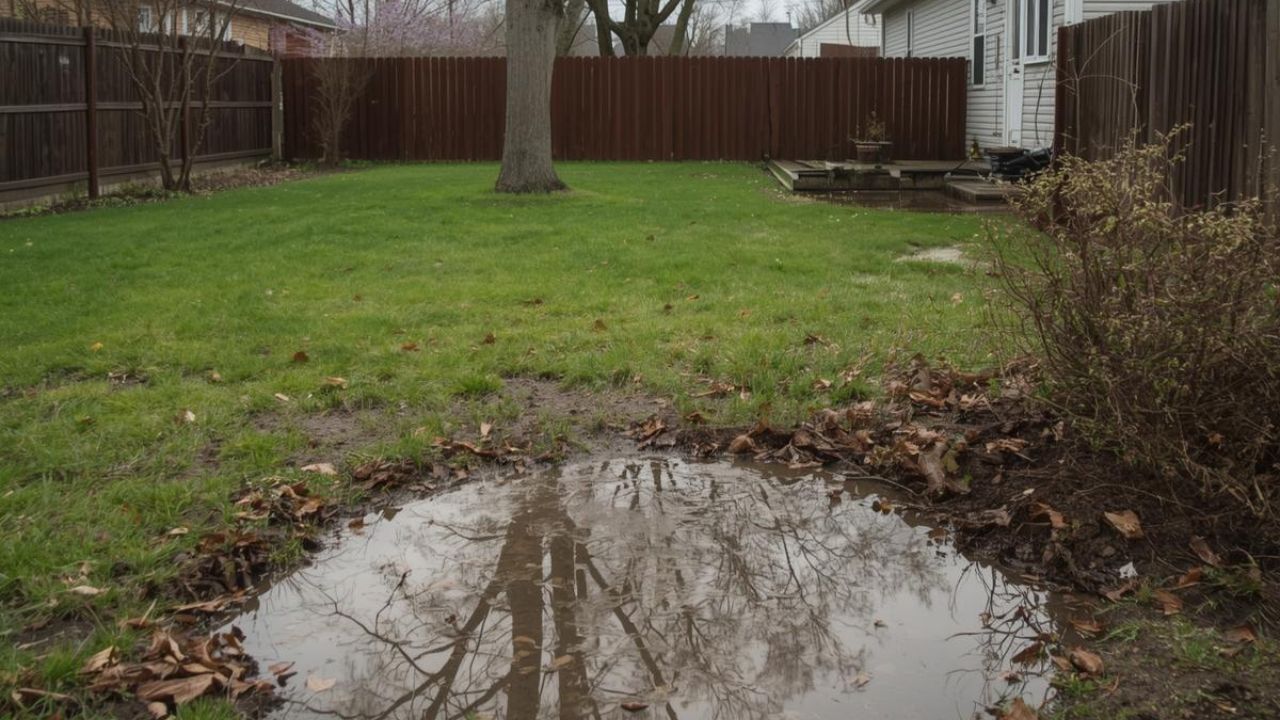
Key Takeaways:
Standing water suffocates grass roots, promotes disease, and destroys lawn aesthetics. Within 48 hours, oxygen depletion begins causing 25% damage. By one month, soil degradation reaches 100% requiring $5,000 to $12,000 complete restoration. Professional drainage systems—achieving 95%+ effectiveness—eliminate pooling permanently, protecting lawn investments and preventing escalating damage.
Waterlogged soil depletes oxygen, washes away nutrients, and creates ideal disease conditions. Grass roots suffocate, fungi proliferate, and compaction worsens drainage in self-perpetuating cycles. Understanding damage mechanisms reveals why immediate intervention saves thousands compared to delayed repairs.
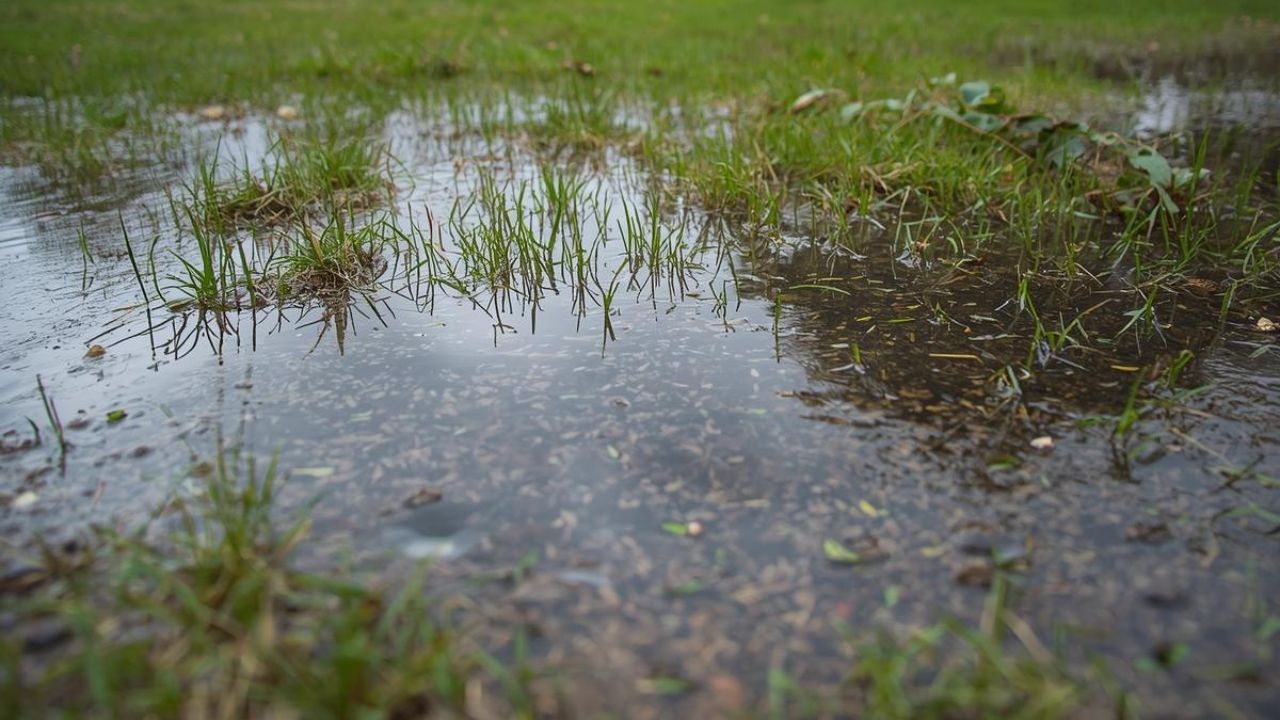
Waterlogged soil lacks oxygen the grass roots need to survive. Oxygen depletion begins within 24-48 hours, stressing roots and causing 25% damage. Saturated soil compacts easily, further reducing pore space and blocking air circulation. This self-perpetuating cycle worsens—pooling causes compaction, which increases pooling.
Excess water washes essential nutrients from root zones. Grass yellows within 3-7 days as nutrient absorption fails despite abundant moisture. Plants literally starve while drowning. Compacted soil reduces infiltration, trapping water at the surface while suffocating roots below.
Wet conditions promote harmful fungi like Pythium and brown patch. These pathogens devastate lawns quickly when combined with oxygen-depleted, weakened grass. Poor drainage creates ideal disease environments accelerating damage beyond simple waterlogging.
Persistent moisture enables thatch buildup and moss invasion. These conditions make recovery difficult even after drainage improvements. Fungal diseases spread rapidly through saturated soil, killing grass faster than water alone. Professional landscaping addresses these interconnected problems with comprehensive drainage solutions.
Dying or oversaturated plants indicate MEDIUM severity problems requiring action within 2-4 weeks at $500 to $3,000 cost. Waterlogged soil suffocates plant roots, causing yellowing leaves and plant death. Visual deterioration progresses predictably—grass yellows, brown patches appear, widespread death occurs.
Extended exposure creates brown dead patches throughout lawns. After 2+ weeks, 90% damage manifests as extensive brown areas requiring $3,000 to $8,000 for full drainage systems plus reseeding or resodding. Soil degradation after one month leaves barren areas where grass won't grow without complete soil amendment and restoration.
Early detection prevents minor problems from escalating into catastrophic failures. Seven professional warning signs carry specific severity ratings, action timelines, and cost implications. Recognizing indicators enables intervention before damage becomes irreversible.
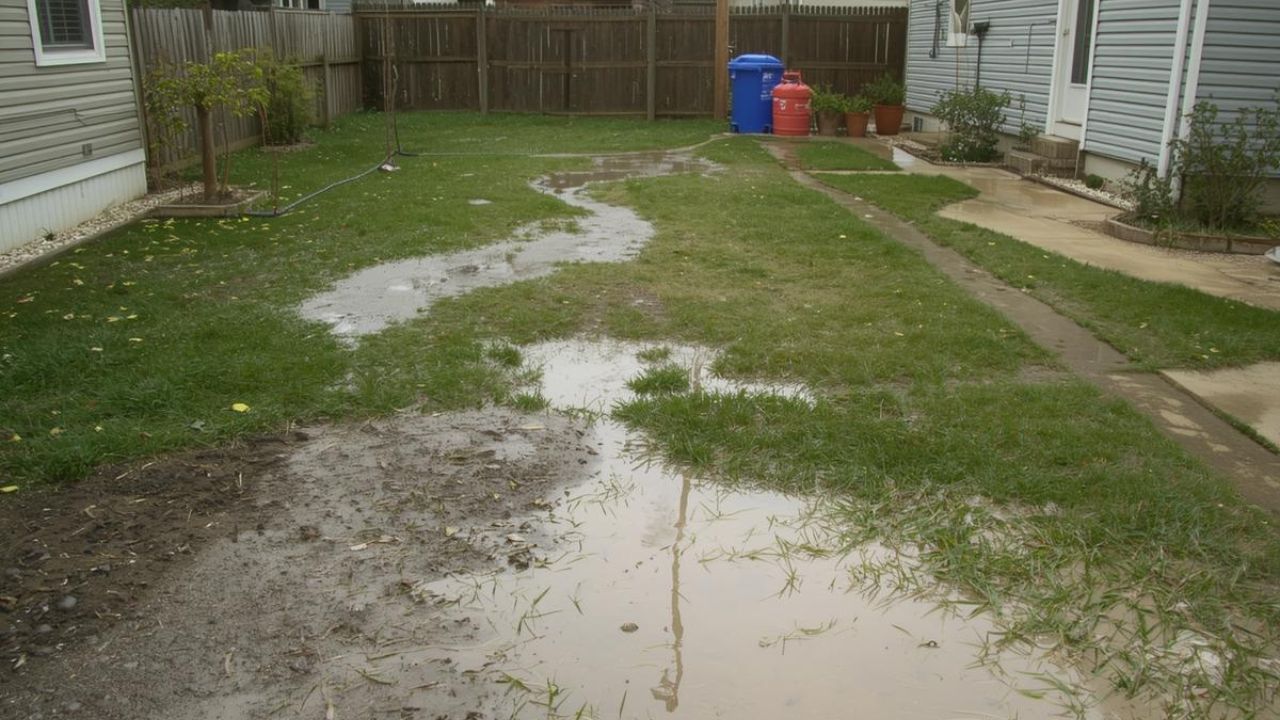
Water remaining 24+ hours after rain signals HIGH severity requiring immediate professional attention costing $2,000 to $8,000. This primary indicator confirms underlying infrastructure problems worsening without intervention. Pooling proves drainage systems are absent or inadequate.
Recurring puddles appearing in identical locations suggest MEDIUM severity issues requiring action within 1-2 weeks at $500 to $5,000 cost. These puddles indicate localized low spots or compacted soil where water naturally collects. Gravity concentrates water in depressions. Without active drainage removing water, problems worsen as pooling increases compaction.
Soggy lawns feeling spongy or staying wet during dry weather signal HIGH severity conditions requiring immediate professional assessment costing $2,000 to $10,000. This indicates high water tables or saturated soil where drainage capacity is overwhelmed. Areas remain wet because water has nowhere to go.
Recurring puddles in identical locations reveal specific problem areas. Localized low spots collect water through gravity. Compacted soil prevents infiltration, trapping surface water. Inadequate slope or grading directs water toward these areas rather than away. Each indicator points to specific drainage failures requiring targeted solutions.
Lawn damage progresses predictably through four stages. Within 0-48 hours, waterlogged spongy lawns show 25% damage from oxygen depletion. Recovery costs $500 to $2,000 through drainage improvement and aeration with 1-2 week recovery. After 3-7 days, yellowing wilting grass indicates 60% damage. Recovery requires drainage plus fungicide and overseeding costing $1,000 to $4,000 with a 3-6 week timeline.
Beyond 2 weeks, brown dead patches signal 90% damage requiring full drainage systems plus reseeding or resodding at $3,000 to $8,000 with 2-4 month recovery. After one month, soil degradation reaches 100% with no growth possible. Complete restoration requires soil amendment costing $5,000 to $12,000 with 6-12 month recovery. Lawn restoration costs $500 to $3,000 beyond drainage system expenses of $2,000 to $8,000.
Multiple drainage solutions address different water sources and site conditions. Effectiveness ratings range from 75% to 98%. Professional systems eliminate over 95% of standing water permanently with proper maintenance. Understanding each system's strengths guides optimal selection.
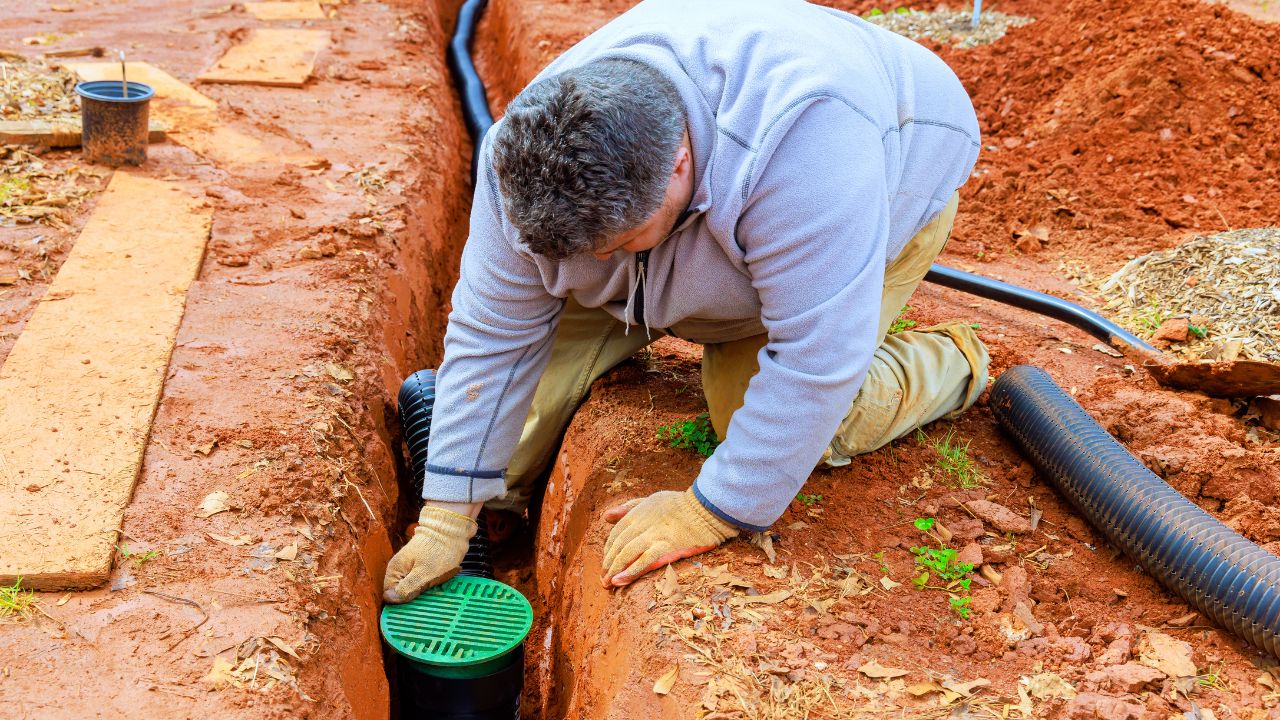
French drains—perforated pipes in gravel-filled trenches—collect and redirect subsurface water at $20 to $30 per linear foot with 95% effectiveness permanently. They excel at subsurface saturation in clay or heavy soil (effectiveness score 10 out of 10), foundation risks (9 out of 10), and basement flooding prevention (8 out of 10). These systems work by intercepting groundwater before it saturates soil and drowns grass roots.
For subsurface saturation in clay or heavy soil, French drains provide optimal solutions. Clay's poor permeability traps water underground, creating perpetually soggy conditions. Alternatives include grading plus dry wells, though these prove less effective in heavy soils. Avoid surface-only solutions ignoring underground water movement—they can't address subsurface saturation problems.
For foundation threats in clay soil, perimeter French drains offer best protection. Installation around foundation perimeters creates dry zones preventing hydrostatic pressure and soil expansion damage. For high water tables, sump pumps combined with French drains work best, actively removing water faster than passive drainage alone. Professional drainage repair implements these systems correctly ensuring long-term effectiveness and proper integration with existing landscape features.
Sump pumps actively remove water from basements and crawl spaces when passive drainage fails, costing $800 to $2,000 with 98% effectiveness—the highest rating among all drainage solutions. They excel at basement flooding prevention (effectiveness score 10 out of 10) and high water table management (7 out of 10 when combined with French drains).
Sump pumps handle poor soil permeability and areas lacking slope for gravity drainage. Active pumping removes water faster than soil absorbs it. Prevention costs of $800 to $2,000 beat basement flooding damage of $5,000 to $20,000 per event. Battery backup ensures operation during power outages accompanying major storms.
Clean gutters prevent overflow cascading down to saturate lawn areas. Professional cleaning costs $100 to $300 with 75% effectiveness through seasonal maintenance managing roof runoff. Thousands of gallons flow through gutters during heavy rain. Clogged gutters concentrate water exactly where it causes maximum damage—at foundations and adjacent lawn areas.
Gutter maintenance prevents standing water where mosquitoes breed. Single females lay 100-300 eggs completing lifecycles from egg to adult in 7-10 days. Mosquitoes carry West Nile virus, Zika, and dengue fever. Clean gutters eliminate breeding sites while protecting lawns from concentrated runoff.
DIY approaches suit minor issues while persistent problems require professional expertise. Understanding limitations prevents wasted effort on ineffective fixes. Cost escalation from delays makes early professional involvement financially prudent.
DIY approaches work for single clogged downspouts costing $100 to $500 through simple fixes—redirecting downspouts, filling low spots, basic grading. Professional assessment becomes crucial for persistent or widespread problems with multiple affected areas, recurring patterns, and visible lawn damage.
Dying plants indicate MEDIUM severity requiring action within 2-4 weeks at $500 to $3,000 cost. When problems persist after DIY attempts, water accumulation increases over time, or multiple drainage issues appear across property, professional intervention prevents escalation. Simple fixes don't address underlying infrastructure failures.
Professionals accurately diagnose water sources—distinguishing surface runoff from groundwater—assess soil conditions properly (clay versus sand versus loam), and recommend effective long-term solutions. They calculate proper slopes requiring precision instruments, size systems correctly for expected water volumes, and design integrated approaches addressing multiple failure points simultaneously. Professional assessment identifies problems DIY evaluations miss—subsurface water movement patterns, soil permeability variations, and compounding issues requiring coordinated solutions.
Cost escalation from delay proves dramatic and financially devastating. Initial signs cost $500. Within 1-6 months, minor issues reach $2,000. By 6-12 months, moderate problems cost $8,000. After 1-2 years, severe damage requires $20,000 repairs. Beyond 2 years, foundation failure demands $50,000 interventions. A $2,000 assessment and solution preventing $20,000 foundation damage represents excellent value. Professional evaluation early in problem development saves exponentially more than delayed emergency intervention.
Professional installation follows assessment (1-2 days), design and planning (1-2 days), installation (3-10 days), and testing and cleanup (1 day). Total projects typically span 5-14 days. Properly installed systems eliminate over 95% of standing water, redirect it 50-100 feet from structures, and include 5+ year warranties.
Professional systems achieve 95%+ effectiveness versus DIY attempts addressing symptoms without fixing root causes. Improper installation worsens problems. Professional work meets code requirements and passes inspections. Permanent solutions with proper maintenance protect lawn investments long-term.
Strategic combinations of drainage systems, grading, and permeable surfaces create comprehensive water management. Material selection and integration determine whether surfaces shed or infiltrate water. Proper system matching to site conditions ensures optimal performance.
Permeable surfaces allow water infiltrating into ground rather than creating concentrated runoff. This distributed infiltration prevents erosion and downstream flooding while reducing total water volume requiring active drainage management. Combined with perimeter French drains, waterproofing membranes, proper grading, and functional gutters, permeable hardscaping reduces total runoff requiring removal or redirection. Permeable pavers work particularly well in high-traffic areas where traditional grass struggles to survive.
Critical dry zones of 6-10 feet around foundations must be maintained to prevent structural damage. Permeable pavers can be part of this protection zone allowing water infiltration rather than runoff concentration toward foundations. Integration during initial installation prevents problems versus correcting them later through expensive remediation. Multi-pronged approaches combining multiple drainage elements—permeable surfaces, French drains, proper grading, functional gutters—work best for comprehensive water management protecting both lawns and structures.
Foundation protection requires comprehensive strategies. What begins as hairline cracks progresses to major structural failure costing $15,000 to $50,000+ for repairs. Protecting foundations involves perimeter French drains, waterproofing membranes, proper grading, functional gutters, and retaining walls for elevation management.
Maintaining minimum 6-10 foot dry zones around foundations proves critical. This buffer allows proper drainage system installation and prevents water-saturated soil from contacting foundations. Retaining walls manage elevation changes while controlling water flow preventing pooling near structures.
Grading reshapes landscapes creating 2-5% slopes away from foundations, costing $1,000 to $5,000 with 80-85% effectiveness permanently. Grading scores perfectly (10 out of 10) for foundation protection and near-perfectly (9 out of 10) for surface pooling elimination. Moderately effective for subsurface saturation (7 out of 10) and basement flooding (6 out of 10).
Catch basins—grated inlets channeling surface water into underground pipes—cost $300 to $800 per basin with 90% effectiveness permanently. Perfect for surface pooling (score 10 out of 10). For surface pooling in any soil type, catch basins combined with grading provide optimal solutions. Channel drains serve as alternatives. Avoid dry wells for surface pooling. Homeowners considering low-maintenance options might explore artificial grass which eliminates many drainage-related lawn problems while maintaining aesthetics.
Channel drains—linear drains in paved surfaces—cost $15 to $40 per linear foot with 85% effectiveness permanently. Perfect for hardscape areas (score 10 out of 10) and effective for surface pooling (8 out of 10). For hardscape drainage, channel drains provide optimal solutions with catch basins as alternatives.
Dry wells—underground structures collecting and slowly releasing water—cost $1,000 to $3,000 with 75% effectiveness permanently. Best for large area drainage in sandy or loam soil where absorption rates support gradual release. For large drainage areas in sandy or loam soil, dry wells combined with French drains work well. Grading serves as an alternative.
Systematic maintenance preserves effectiveness and prevents failures. Seasonal tasks address specific challenges—spring prevention, summer monitoring, fall preparation, winter protection. Regular inspection catches problems when repairs are simple and inexpensive.
Annual inspection minimum recommended. Ideally inspect twice yearly—spring and fall. Professional systems include 5+ year warranties but require maintenance for optimal performance. Early detection catches problems when repairs are simple and inexpensive.
Small clogs clear easily when caught early. Settled soil can be regraded quickly before major problems develop. Minor cracks get sealed before expansion. Preventive approaches preserve both systems and structures they protect. Regular inspection prevents minor $500 to $2,000 repairs from becoming $10,000 to $50,000+ foundation failures.
Spring maintenance focuses on critical prevention. Inspect all drains and clear debris—a HIGH priority 2-4 hour annual task. Test sump pumps and check batteries—a CRITICAL priority 1-hour annual task preventing emergency failures. Aerate lawns and check grading—a MEDIUM priority 3-5 hour annual task maintaining proper slopes. Apply mosquito larvicide and repair winter freeze-thaw damage.
Summer maintenance emphasizes peak monitoring. Monitor after storms weekly—a HIGH priority 30-minute task catching problems early. Clean gutters monthly—a MEDIUM priority 1-2 hour task preventing overflow. Check catch basins monthly to maintain capacity. Water lawns properly avoid oversaturation. Watch for fungal diseases requiring immediate treatment. Maintain 6-10 foot dry zones around foundations. Just as cooling outdoor spaces requires regular system maintenance, drainage systems need consistent attention for optimal performance.
Fall maintenance prepares for winter. Final gutter cleaning is a HIGH priority 2-3 hour annual task removing leaves before winter precipitation. Inspect foundations—a HIGH priority 1-2 hour annual task identifying issues before freeze-thaw damage. Test drainage flow verifying all systems work. Winterize systems for freeze-thaw cycles. Document problem areas for spring repairs.
Winter maintenance protects systems. Check basements monthly—a MEDIUM priority 30-minute task monitoring freeze-thaw impacts. Clear snow from drains prevents ice dams. Plan spring projects, review warranties, and budget for repairs ensuring funds available when needed.
Clogged systems perform poorly or fail completely. Early detection prevents minor $500 to $2,000 repairs from becoming $10,000 to $50,000+ foundation failures. Preventive approaches preserve both systems and structures they protect. Regular maintenance prevents system failure.
Standing water creates prime mosquito breeding grounds. Single females lay 100-300 eggs in small amounts of stagnant water. The entire lifecycle completes in 7-10 days: eggs (day 0), larvae (day 2), pupae (day 4.5), adults (day 8.5). Fast drainage through French drains or catch basins achieves 95%+ effectiveness permanently at $2,000 to $8,000, completely eliminating breeding sites. Installing drainage systems eliminates standing water within 7 days—faster than mosquitoes complete their breeding cycle. Permanent solutions prevent recurring infestations protecting health while preserving lawn quality.
Contractor selection determines solution quality and longevity. Experience, licensing, insurance, and warranties separate qualified professionals from inadequate contractors. Proper questions reveal expertise and ensure code-compliant installations protecting investments.
Request portfolios showing completed drainage installations. Ask for references from clients with comparable flooding challenges you can contact directly. Verify experience with your specific soil type—clay requires different solutions than sand. Sandy or loam soil has different drainage characteristics affecting solution selection significantly.
Contractors comfortable with multiple solutions demonstrate comprehensive expertise: French drains, catch basins, sump pumps, and integrated systems. Check track records with professional installations achieving 95%+ effectiveness ratings. Avoid contractors limited to single solution types who force-fit specialties regardless of actual needs.
Licensed professionals ensure compliance with local building codes and drainage regulations. Insurance protects homeowners from liability during installation. Professional contractors provide 5+ year warranty standard coverage. Proper installation proves critical for achieving 95%+ effectiveness ratings.
Professional installations eliminate over 95% of standing water, redirect it 50-100 feet from structures, and include warranties ensuring free repairs if systems fail prematurely. This eliminates out-of-pocket costs for defective workmanship or materials. Drainage work often requires permits—licensed contractors handle applications and inspections. Unlicensed contractors expose you to code violation liability complicating future property sales and creating legal exposure.
Ask about assessment processes—typically requiring 1-2 days for thorough evaluation. Inquire about installation timelines—typically 3-10 days for installation phase. Verify total timeline from initial contact to completed, warranted installation. Typical total projects span 5-14 days.
Request detailed cost breakdowns: assessment and design costs, material costs, labor costs, and warranty terms. Verify licensing and insurance coverage with certificate copies. Ask about warranty coverage—standard is 5+ years for professional installations. Request references from similar projects you can verify.
Confirm they achieve 95%+ effectiveness in standing water elimination—not just improvement. Ask about ongoing maintenance requirements—what you must do versus what they'll service. Verify ability to redirect water 50-100 feet from structures safely. Verify solution-specific cost ranges: French drains $20-$30 per linear foot, catch basins $300-$800 per basin, channel drains $15-$40 per linear foot, sump pumps $800-$2,000, grading $1,000-$5,000, dry wells $1,000-$3,000.
Standing water destroys lawns through root suffocation, disease promotion, and soil degradation. Damage progresses from 25% within 48 hours to 100% after one month requiring $5,000 to $12,000 complete restoration. Professional drainage systems—French drains at $20 to $30 per linear foot achieving 95% effectiveness, sump pumps at $800 to $2,000 delivering 98% effectiveness—eliminate pooling permanently.
Don't wait for widespread grass death or soil degradation forcing complete lawn replacement. Signature Landscape specializes in comprehensive drainage solutions for Orange County properties. Our licensed professionals diagnose drainage failures, design integrated systems, and install warranted solutions achieving 95%+ standing water elimination. You can request a free quote to understand what quality drainage solutions cost for your specific lawn conditions.
 Signature Landscape
Schedule A Consultation