Call our Professional Contractors!
(949) 859-9969
Key Takeaways:
Most Orange County homeowners live in master-planned communities governed by HOAs with enforceable architectural standards. Ignoring those standards before starting a hardscape project does not save time. It creates fines, forced removal, and legal disputes that cost far more than the approval process ever would.
HOA compliance is not optional paperwork. It is a mandatory pre-construction requirement with real financial consequences if skipped.
The HOA Architectural Review Committee, known as the ARC, governs all permanent exterior modifications including patios, driveways, walkways, retaining walls, pool decks, outdoor kitchens, and fire features. No work begins before ARC approval is received in writing. Ignoring this process can result in costly fines, forced removal of a completed installation, and legal disputes.
Many homeowners assume a city building permit covers everything. It does not. City permits evaluate structural safety. HOA review evaluates aesthetics, materials, drainage impact, and neighborhood standards. Both are required. Both run on separate timelines. A project can be fully permitted by the city and still be non-compliant with HOA CC&Rs. A typical Orange County hardscape project runs 22 to 24 weeks from start to completion. HOA architectural review alone takes 30 to 45 days and must be completed before construction begins.
The rules governing your project are already written down. Reading them before you design anything saves time, money, and the frustration of a rejection you could have avoided.
Every Orange County HOA community governs hardscaping through its Covenants, Conditions, and Restrictions and supplemental Architectural Design Guidelines. These documents define approved materials, required setbacks, lot coverage limits, and the submission process. Review them before selecting a design or material. Discovering a restriction after finalizing plans requires a full redesign and restarts the approval timeline.
Many Orange County HOA communities maintain an approved palette of colors and materials. Earth-toned concrete pavers are commonly approved. Brightly colored stamped concrete or conflicting natural stone is frequently prohibited. Most HOAs require hardscaping to maintain a 3 to 5 foot setback from property lines for raised elements such as seating walls, retaining walls, and fire pits. HOAs increasingly require or encourage permeable paver systems to reduce stormwater runoff, and some communities have made them mandatory for all new hardscape installations.
HOAs frequently cap the percentage of a lot that can be covered by impermeable surfaces. Exceeding that limit after installation is a compliance violation that can require partial removal. Front yard hardscape faces the most stringent aesthetic review because it directly affects the community's street-facing appearance, which is the primary standard most ARC committees are empowered to enforce.
Nearly every permanent exterior improvement in an HOA community requires review. Some categories face more scrutiny than others.
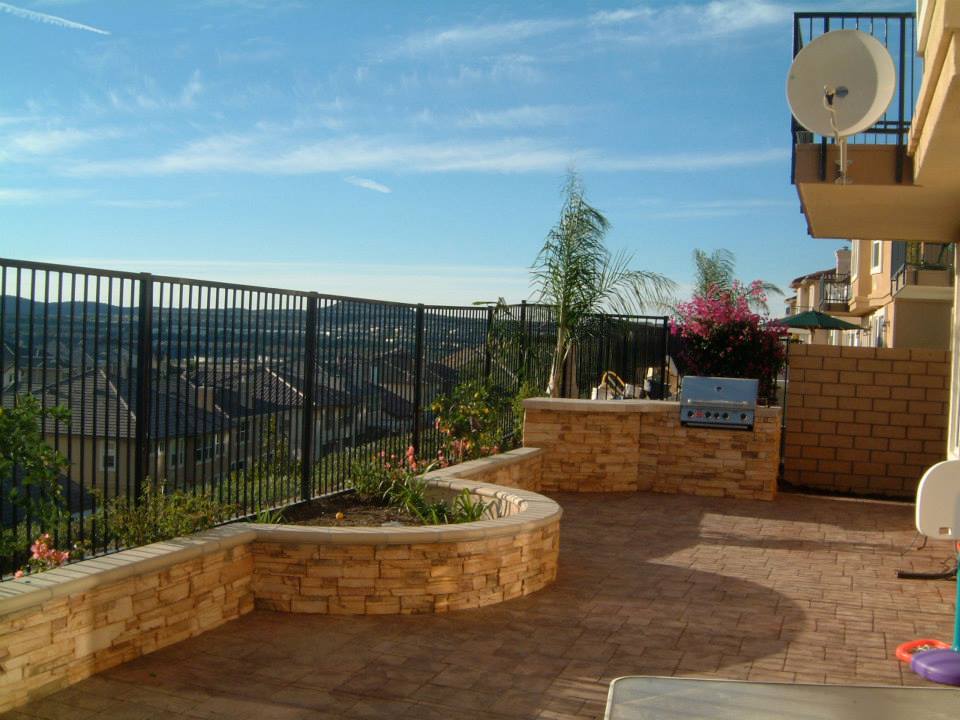
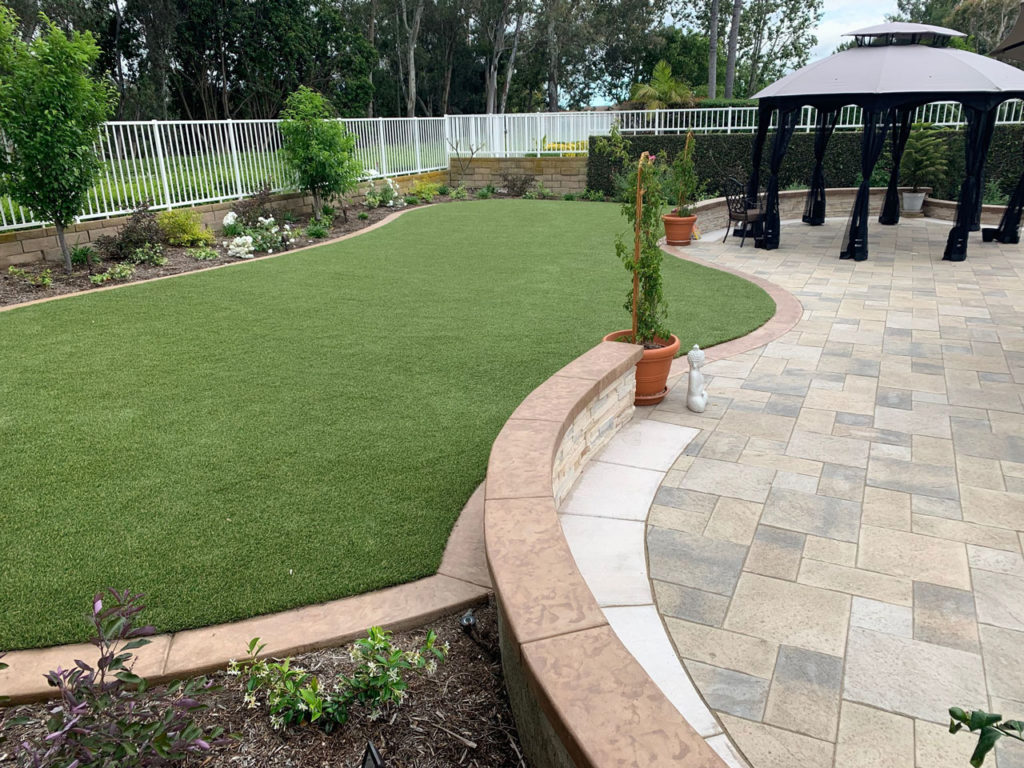
Patios and paver installations affect drainage, lot coverage, and neighborhood visual standards — all three primary ARC review criteria. A real example: a 350 square foot Irvine HOA concrete paver patio with a seating wall required a complete drainage map showing runoff directed to street drains. HOA approval took 45 days. The project passed inspection on the first attempt because the submission was complete from the start.
Retaining walls are among the most heavily reviewed project types because they affect drainage, property line boundaries, neighbor sightlines, and structural stability simultaneously. California law prohibits altering grading in ways that direct water runoff onto a neighbor's property. HOAs enforce this strictly. A retaining wall built without proper drainage compliance creates both an HOA violation and a property liability that affects insurability and resale.
Outdoor kitchens, fire pits, and fire features require ARC review because they involve gas line connections, open flame, setback compliance, and permanent structural additions. Outdoor fireplace chimneys require a minimum 7-foot setback from the property line and a 10-foot setback from any building. These requirements are enforced by both Orange County building code and most HOA CC&Rs. Review fire-safe landscaping guidance for Orange County alongside your HOA rules when planning any fire feature to ensure full compliance on both fronts.
The HOA approval process follows a defined sequence. Understanding what each step requires prevents delays before they happen.
A complete Orange County ARC submission requires: a filled and signed ARC application form, a to-scale site plan showing property lines and proposed hardscape dimensions, a drainage plan confirming water flow will not enter adjacent lots, material samples or manufacturer specifications with brand and color name, contractor information including CSLB license number, a certificate of insurance showing general liability and workers' compensation coverage, neighbor notification forms where required, and payment of any review fees or construction deposits. Missing any one of these resets the clock.
A complete submission takes 30 to 45 days to review. An incomplete submission that triggers a revision request resets that entire window. The full project timeline from planning initiation to completion runs 22 to 24 weeks. Paver installation does not begin until approximately week 17. A homeowner who wants a completed project in eight weeks has already missed the realistic window.
Most HOA rejections trace back to a small number of predictable design decisions. Knowing them in advance makes first-submission approval achievable.
HOA material restrictions specify an approved palette that reflects community-wide aesthetic standards. A vague description of "gray pavers" is not sufficient for ARC review. The submission must include the specific brand, product line, color name, and finish. Material samples or manufacturer brochures are required. Submitting exact specifications with the first package is the single most effective way to prevent a rejection on aesthetic grounds.
Drainage compliance is typically the most critical review criterion. California law prohibits directing runoff onto a neighbor's property. HOAs require detailed drainage plans showing water flow direction and drain locations with every submission. Setback violations are the second most common cause of rejection. Most Orange County HOAs require a 3 to 5 foot setback from property lines for raised structures, and outdoor fireplace chimneys require a 7-foot setback from the property line and 10 feet from any building. Confirming both before design is finalized eliminates the most frequent grounds for denial.
The most expensive HOA problems happen after construction begins. Every one of them is preventable with the right preparation.
Starting construction before receiving written HOA approval can trigger a stop-work order, mandatory demolition of completed work, financial penalties, and legal action. Any contractor who suggests starting before written approval has been received is creating liability for the homeowner, not protecting them. Written approval is the only approval that counts.
An incomplete ARC submission that is missing any required document causes a revision request that resets the 30 to 45 day review clock. Specifying "concrete pavers" without brand, color name, product line, and finish is insufficient for ARC review in most Orange County communities. The four most common causes of revision requests are: drainage plans that fail to demonstrate compliant water flow, materials outside the approved palette, setback violations, and lot coverage calculations that exceed the maximum impervious surface ratio in the CC&Rs. Neighbor notification, where required, is a procedural step that delays approval when skipped regardless of plan quality.
Multi-feature projects trigger multiple ARC review criteria simultaneously. The more elements in the plan, the more important it is to submit a complete, integrated design from the start.
A project combining a paver patio, retaining wall, outdoor kitchen, fire feature, and drainage improvements simultaneously triggers aesthetic standards, setback requirements, lot coverage limits, drainage compliance, and gas and electrical infrastructure review. Each has separate documentation requirements. A complete backyard entertainment project costs approximately $75,000 at mid-range in Orange County. At that investment level, HOA non-compliance is not a procedural inconvenience. Forced demolition of a project at that scale is a financial catastrophe.
The correct project sequence is: design and HOA submission in weeks 0 to 4, HOA review in weeks 4 to 8, city permit application after HOA approval in weeks 8 to 12, contractor scheduling and material ordering in weeks 12 to 15, site preparation and construction in weeks 15 to 21, and final HOA inspection in weeks 21 to 24. Gas line and electrical permits run after HOA approval. Scheduling a contractor for utility rough-in before both approvals are confirmed creates timeline risk that a professional project manager eliminates by default.
Projects involving slope work, drainage mitigation, or property walls require the most thorough documentation in any ARC submission. The drainage plan must show existing and proposed grades, water flow direction across the full property, all new drainage infrastructure locations, and confirmation that no runoff is redirected onto neighboring properties. Site preparation and excavation represents 10% to 20% of total project cost for standard paver work and increases significantly for slope and drainage mitigation. That full cost must be reflected in both the project budget and the HOA submission.
A rejection or revision request is not the end of the project. It is a specific instruction about what needs to change.
When the ARC requests a revision targeting a specific element such as a drainage plan, material specification, or setback measurement, revise only that element and resubmit with a cover note identifying the exact change made. Broad redesigns in response to narrow revision requests waste time and reopen questions the committee has not raised. If a material is rejected, request the approved materials list directly from the ARC or HOA management company. If a standard impermeable paver is denied on lot coverage or drainage grounds, a permeable paver system at $18 to $35 per square foot may satisfy both the design goal and the compliance requirement simultaneously.
A written explanation from the ARC creates a documented record of the specific rule being applied. Verbal approvals and verbal rejections are both legally unenforceable. A variance request is appropriate when a design element is not prohibited by the CC&Rs but falls outside standard parameters. It must be submitted formally with supporting documentation. Raising it verbally with a board member accomplishes nothing and creates no record. Coordinating your outdoor living design with seasonal landscaping planning during the revision period is a productive use of the waiting time.
Any hardscape project in an HOA community benefits from professional involvement. Projects that involve drainage, structural walls, gas lines, or premium materials require it.
A professional contractor familiar with Orange County HOA requirements prepares a complete ARC submission package including a to-scale site plan, drainage plan, material specifications with brand and color documentation, CSLB license number, and certificate of insurance. California law requires a CSLB-licensed contractor for any project exceeding $500 in labor and materials. For hardscape work, that means a C-27 (Landscaping) or C-8 (Concrete) license. That same licensing standard is what ARC committees use to evaluate contractor credibility in a submission package.
A detailed CAD site plan completed before ARC submission allows the committee to evaluate the project with architectural precision and allows the homeowner to identify compliance conflicts before they become revision triggers. The most expensive hardscape mistakes — scope changes mid-construction, failed HOA inspections, drainage violations post-installation, and base failures requiring full removal — are almost entirely preventable with thorough planning before any work begins.
A contractor with direct local project experience also knows which materials are on approved palettes in specific communities and which drainage solutions are pre-approved by local ARCs, knowledge that is not available from reading the CC&Rs alone.
Orange County homeowners who treat HOA compliance as part of the design process rather than a hurdle at the end of it complete their projects on time and on budget. Review the CC&Rs before finalizing any design. Confirm approved materials and setback requirements before specifying any feature. Start the ARC submission no later than eight weeks before the desired construction start date. Receive written approval before setting a construction date. Verify the contractor's CSLB license before signing anything.
Signature Landscape has been designing and building hardscape environments across Orange County for over 38 years. The team prepares complete HOA submission packages, navigates ARC approvals, and builds to code on every project. Request a free quote and work with a contractor who knows Orange County's HOA landscape as well as they know the hardships itself.
Schedule A Consultation